INTERMEDIATE
MAD01: Madina Book 1 Explained and Expounded
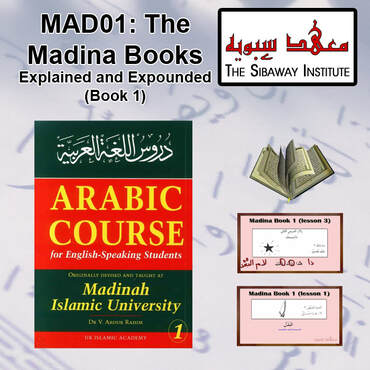
This will be an ongoing series which will aim to get students to master the material covered in the Madina Books. The aim will be to develop teachers who are able to teach these books in their locality to spread the Language of the Quran. The reason for concentrating on the Madina Books is because of its popularity and accessibility to all students around the world.
The course will leave no stone unturned and address all the details not covered in the Books through the classical sources. The lessons will have a strong focus on the Quran linguistic miracle and the beauty and precision of the Arabic language which will serve as motivation for students and aspiring teachers. We will answer all Student questions and have them available for other students to view.
Students can enroll in this course and get access to the course material and be able to download it for future reference. The student will also have access to online teachers as well as extra lessons when they become available.
The course will leave no stone unturned and address all the details not covered in the Books through the classical sources. The lessons will have a strong focus on the Quran linguistic miracle and the beauty and precision of the Arabic language which will serve as motivation for students and aspiring teachers. We will answer all Student questions and have them available for other students to view.
Students can enroll in this course and get access to the course material and be able to download it for future reference. The student will also have access to online teachers as well as extra lessons when they become available.
BOOKS AND HANDOUTS
BOOK FOR DEDICATED LESSONS BY USTADH ASIF MAHERALI.
LESSON 1 (PAGE 5)
The demonstrative pronoun هذا , the ها of drawing attention, introduction to base letters, interrogation with أ and ما and من , the deep meanings of Arabic roots.
ANIMATED VIDEOS IN HD
LESSON 2 (PAGE 12)
The demonstrative pronoun ذلِكَ , interrogation with أ and ما and من , pronoun and Laam of distance.
LESSON 3 (PAGE 14)
The definite article, different structures of the nominal sentence, different noun patterns, the active and passive participle, importance of the science of tajweed
LESSON 4 (PAGE 21)
Introduction the prepositions في إلى من على . The importance and the vast usage of particles. Introduction to proper nouns, the deep meanings of Arabic roots and how one can improve memorization of new words.
Dedicated tuition
LESSON 5 (PAGE 27)
Starting الإضافة and the preposition لام ( used for ownership), word order of a nominal sentence and changing of meanings, The adverb and demonstrative pronouns هنا هناك هنالك , interrogation with ما and من (cont). How to use the Hans Wehr Dictionary with the verb خَرَجَ and the different meanings of the verb when different prepositions are associated to it.
LESSON 6 (PAGE 33)
Construction of the feminine singular demonstrative pronoun هذه. How does an اسم الفاعل resemble the verb. Linguistic discussions on the words used in lessons. Names of some body parts. Discussion on the patterns of the noun used for an instrument.
Dedicated tuition
LESSON 7 (PAGE 39)
Construction of the feminine singular demonstrative pronoun تلك. Linguistic discussions on the words used in lessons. Difference between using لام of ownership and الإضافة
LESSON 8 (PAGE 42)
Introduction to بدل ( the substitute). How to identify if a word is a substitute or predicate. Declension of nouns that end with an Alif. Detailed analysis of exercise questions.
Dedicated tuition
LESSON 9 (PAGE 47)
Introduction to the نَعْت ( the Adjective). The Adjective as a single word or a sentence. The relative pronoun used as an adjective. The Sifah pattern of فَعْلَان and its usage. How to identify the role of different parts of a sentence. Detailed analysis of exercise questions.
Dedicated tuition
LESSON 10 (PAGE 54)
Introduction to the proposition ب and ل . Masculine proper names with a feminine sign. Associated prepositional phrases and adverbial phrases. A sentence coming as a predicate. Negation with ما in a nominal sentence. linguistic discussion on the word zawj. Introduction to the Ism Maqsoor.
Dedicated tuition
LESSON 11 (PAGE 61) - REVISION LESSON
Dedicated tuition
LESSON 12 (PAGE 63)
Introduction to femininity. The feminine nouns and pronouns. Linguistic analysis of asking a question with كيف.
Dedicated tuition
LESSON 13 (PAGE 68)
The Broken and sound masculine plurals. Introduction to the lesser and greater plural. Plural masculine demonstrative pronouns. proper nouns with an Alif Maqsoora. Other linguistic discussions related to sentence structure and meaning of words in classical Arabic and the Quran.
Dedicated tuition
LESSON 14 (PAGE 82)
The attached and detached masculine personal pronouns . Discussion on Non arabic names. Discussion on the noun of interrogation أيّ and its place of Iraab. the lesser and greater plural. Plural masculine demonstrative pronouns. proper nouns with an Alif Maqsoora. Other linguistic discussions related to the lesson.
Dedicated tuition
LESSON 15 (PAGE 87)
The attached and detached feminine personal pronouns . Discussion on the Adverb and its various structures and its association to a verb. Linguistic discussion on the word صلاة . Other linguistic discussions related to the lesson.
Dedicated tuition
LESSON 16 (PAGE 92)
The Broken Plurals and plural patterns. Detailed linguistic discussion on the different types of plurals and their usage. Non conventional usages of plurals and discussion on the lesser and greater plural. Examples of the lesser and greater plural in the Quran.
LESSON 17 (PAGE 96)
Using an appropriate predicate with a Plural subject. Use of multiple predicates with or without separation with a conjunction. Detailed discussion on the omitted predicate (khabar).
Dedicated tuition
LESSON 18 (PAGE 100)
The interrogative كَمْ and the clarifying noun . The Dual noun and demonstrative pronouns and how they decline. Iraab of nouns that end in an Alif maqsoorah.
Dedicated tuition
LESSON 19 (PAGE 105)
Further discussions on the Alif maqsoorah and plurals. Counting masculine nouns from one to ten.
Dedicated tuition
LESSON 20 (PAGE 109)
Discussion on signs of a feminine noun . Counting feminine nouns from one to ten and unique form of the number 8. Iraab of of the Ism Manqoos.
Dedicated tuition
LESSON 21 (PAGE 114)
Revision lesson. Discussion of the laam of distance in demonstrative pronouns.
Dedicated tuition
LESSON 22 (PAGE 117)
Proper Nouns and adjectives that are prevented from declining normally.
Dedicated tuition
LESSON 23 (PAGE 120)
Nouns that are prevented from declining normally in the genitive case.
Dedicated tuition
PROFICIENCY TEST
The following is a proficiency test that one can undertake after completing Book 1. If you have any questions regarding the test or want to hand in your answers for review please email Ustadh Nabeel at nabeel@sibawayinstitute.com